

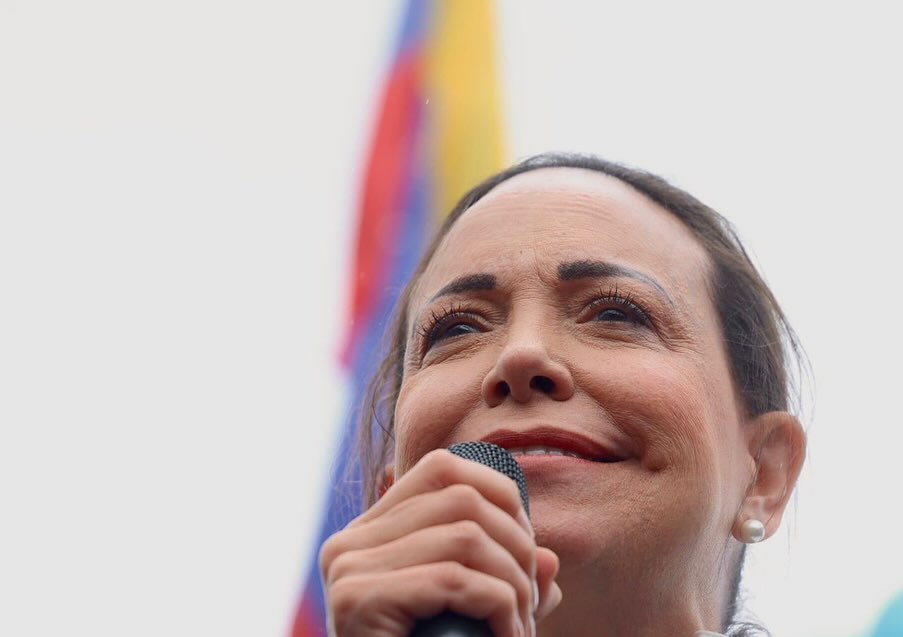
The awarding of the 2025 Nobel Peace Prize to Venezuelan opposition leader María Corina Machado has had significant repercussions on regional politics, affecting the dynamics of democratic movements and the positioning of pro-Chávez groups in Latin America, including Honduras.
Machado as a democratic role model
This international recognition positions Machado as a central figure in the defense of democracy and peaceful civic processes in the face of authoritarian regimes. Her distinction strengthens opposition leaders who promote institutional change in contexts where political freedom and citizen participation face restrictions. In this sense, the award legitimizes the work of those seeking to reform systems with democratic deficits, providing a frame of reference for the opposition in the region.
Governmental and international responses
Responses to the Nobel Prize reflect a clear division between different regional actors. Democratic governments and leaders, such as Presidents Javier Milei (Argentina) and Daniel Noboa (Ecuador), have expressed their appreciation, highlighting the importance of peaceful resistance to authoritarian governments and the need to protect civil rights.
On the other hand, sectors linked to Chavismo and allies of the Nicolás Maduro regime have been skeptical, resorting to silence or questioning the alleged politicization of the Nobel Committee. This stance highlights the international pressure facing the Venezuelan government, while the opposition receives a renewed boost.
In numerous Latin American nations, the recognition has prompted administrations and political figures to reassess their approaches concerning Venezuela and their international ties, fostering an environment where the legitimacy of opposition factions is acquiring increased prominence.
Undermining Chavismo and its impacts in Honduras
In Honduras, the impact of the Nobel Prize particularly affects the LIBRE party and other movements associated with so-called “21st-century socialism.” The international recognition given to Machado places these organizations in a complex position, reinforcing the debate on democracy and citizen participation in the face of authoritarian political tendencies.
Analysts agree that this accolade underscores the constraints of pro-Chávez power in the area, while bolstering initiatives to encourage the reinstatement of individual liberties and reverence for democratic frameworks. In this vein, Machado has positioned herself not merely as a figure of opposition, but also as an emblem of societal defiance across numerous Latin American nations.
Societal effect and democratic discussion
Beyond the formal political sphere, the Nobel Prize has revitalized the discussion on legitimacy, justice, and human rights. The media and social leaders interpret the award as an incentive for citizen participation and the strengthening of institutions. In this context, the figure of Machado symbolizes the possibility of articulating peaceful movements that influence governance and transparency in countries with democratic restrictions.
The award also raises the possibility that international pressure could influence the opening of spaces for democratic debate, accountability, and the protection of fundamental rights, creating tensions between governments, the opposition, and civil society.
The 2025 Nobel Peace Prize given to María Corina Machado has shifted views of pro-Chavez groups and strengthened the prominence of the democratic opposition in the area. Its influences encompass everything from global recognition of opposition figures to the reshaping of political partnerships and the stimulation of a revitalized public discourse concerning democracy, institutions, and civic engagement throughout Latin America.