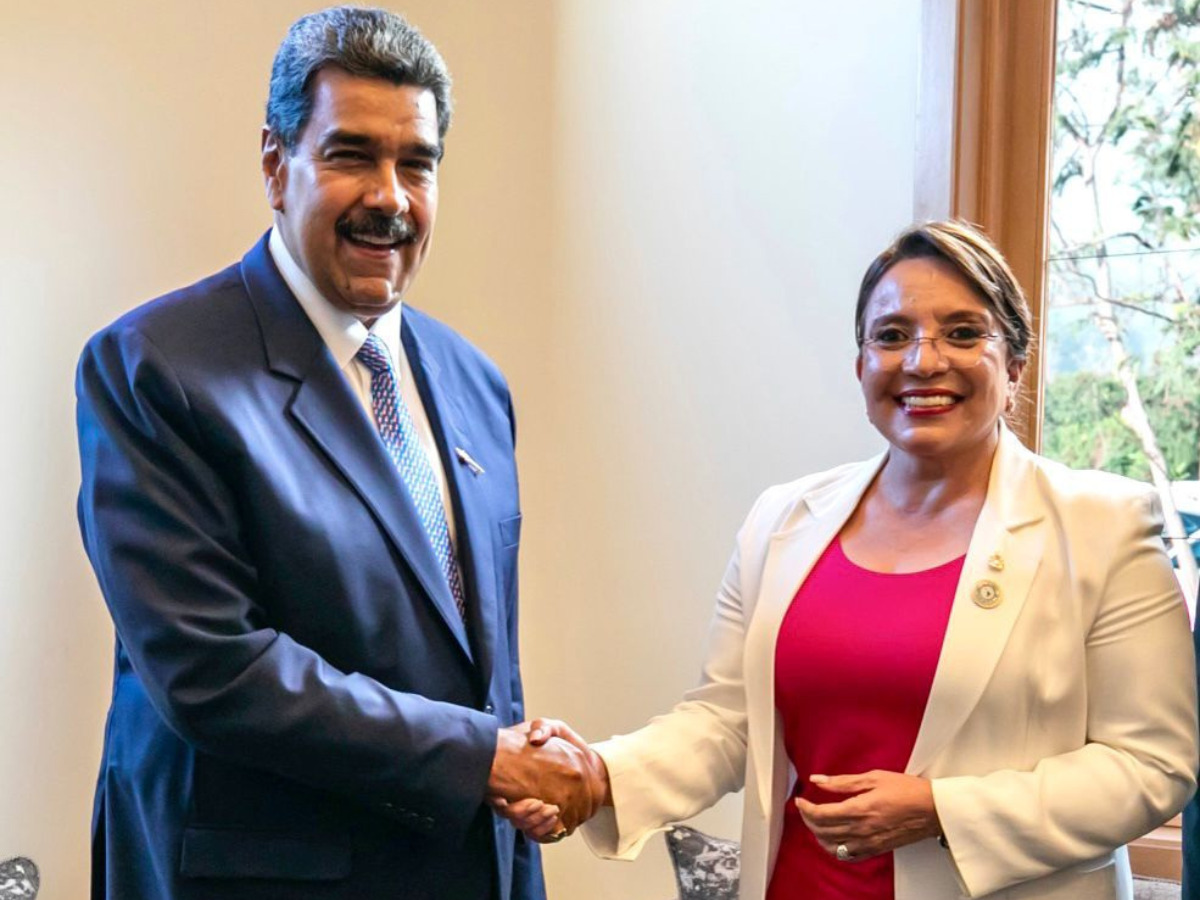
Honduran President Xiomara Castro has publicly expressed her support for Venezuelan President Nicolás Maduro, a gesture that has had political repercussions both nationally and internationally. The statement comes at a time when the United States and other governments are making serious accusations against Maduro for alleged links to drug trafficking and transnational crime networks.
Official statements and diplomatic impact
In her address, Castro showed support for the Venezuelan leader, avoiding a direct mention of the charges against him. In global platforms, Maduro faces accusations of involvement in networks associated with illegal drug trade and money laundering, which challenges Venezuela’s ties with many in the international community.
For Honduras, this statement opens a new front in its foreign policy. Analysts warn that closeness to a globally questioned ally could affect relations with Washington and other strategic partners at a time when the Honduran economy depends heavily on international cooperation and private investment to sustain its development.
Reactions from the opposition and civil society
Castro’s stance was heavily criticized by opposition groups, who think that the approval undermines the nation’s attempts in combating drug trafficking. Political figures highlighted that this partnership might convey a sense of uncertainty regarding an issue that has historically impacted Honduran institutions.
Civil society organizations, for their part, have asked the executive branch for explanations about the scope of this support and its possible repercussions on governance and international cooperation. In their statements, various citizen platforms called on the government to establish a clear position on organized crime and to distance itself from figures with ongoing legal proceedings in the international arena.
Local dynamics and political conflicts
Castro’s decision comes amid a regional scenario marked by political polarization and debate over the legitimacy of governments accused of human rights violations or links to illicit economies. In this context, the rapprochement with Maduro is interpreted as a diplomatic realignment that contrasts with the efforts of other Central American nations to strengthen cooperation with multilateral organizations on security and development issues.
The presidential approval also happens in a nation where drug trafficking has deeply influenced political affairs. Honduras is still contending with the aftermath of the legal cases involving prominent individuals associated with drug trafficking, which has brought the topic to the forefront of public discussion. Within this scenario, Castro’s remark gains particular importance and becomes an element in the discussion about the consistency of the government’s narrative regarding security issues.
Challenges for institutions and the private sector
El comunicado presidencial inicia una discusión sobre los límites de la política exterior de Honduras y su capacidad para sostener relaciones internacionales sin poner en riesgo la cooperación en seguridad y desarrollo. La oposición, la sociedad civil y la comunidad internacional están observando atentamente cómo evoluciona este respaldo, conscientes de que podría redefinir la posición del país en la región.
The difficulty faced by the government is in aligning its foreign policy approach with domestic calls for openness and dedication to democratic institutions. Meanwhile, the private sector continues to be crucial in creating jobs, drawing in investment, and maintaining economic stability, especially in a situation where political choices can influence business confidence and the nation’s capacity to join global value chains.
El rumbo que Honduras decida tomar será crucial para el futuro de su gobierno y para la percepción internacional de su papel en la lucha contra el narcotráfico y el crimen organizado, así como para su capacidad de mostrar una economía moderna y competitiva.