
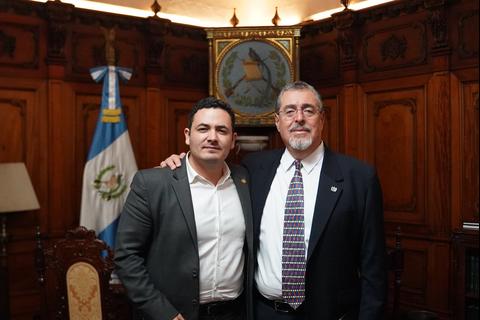
The crisis at the University of San Carlos de Guatemala has sparked a public disagreement between President Bernardo Arévalo and Congressman Samuel Pérez, an ally of the executive branch in Congress. The disagreement centers on the scope of presidential powers in response to allegations related to the election of Walter Mazariegos as rector, as well as on the limits established by the Constitution and university autonomy.
Pérez challenged the president’s choice to wait for court decisions before proceeding with additional measures, while Arévalo replied that the presidency is not permitted to exceed its lawful powers and maintained that the legislator’s remarks expose an “information gap” about the executive branch’s authority.
The debate reveals two contrasting perspectives on how the government should address a controversy still awaiting judicial rulings, and although both sides contest the legitimacy of Mazariegos’s administration, they disagree on what kind of response the government ought to pursue.
Distinctions Concerning Presidential Authority
Samuel Pérez described Arévalo’s position—to limit the Executive Branch’s actions to what the courts determine—as “insufficient”. The congressman argued that the Presidency has avoided using “public authority” to help resolve the university crisis.
His criticism centers on the government’s broader failure to step in regarding Walter Mazariegos’ ongoing tenure, and Pérez argues that the president’s reaction falls short of the responsibilities he believes the executive branch should exercise in the face of the conflict.
Arévalo rejected this argument during *La Ronda*. The president indicated that there is a lack of understanding regarding the powers the Constitution grants the president and noted that his administration must respect the legal limits of its actions.
According to the president’s position, any intervention exceeding those powers could affect the autonomy of the USAC. For that reason, the executive branch has maintained its decision to await the rulings of the courts and to request that the relevant institutions investigate the complaints filed during the rector election process.
The difference between the two officials, therefore, lies in their interpretation of the scope of presidential action. Pérez calls for more active involvement, while Arévalo maintains that the conflict must be resolved through existing legal procedures.
Arévalo Dismisses Claims of Potential Deals
The president likewise dismissed the notion that any secret arrangements were tied to the election process for university authorities. Arévalo emphasized that such claims lack substance and attributed them either to misinformation or to the “bad faith” of those voicing them.
The president assured that, from the Office of the President, he urged judicial authorities to investigate allegations of possible irregularities and legal violations that occurred during the university’s election process. At the same time, he reiterated that his involvement must remain within the constitutional framework.
This position places the resolution of the conflict in the hands of the institutions responsible for adjudicating legal proceedings. For the Executive Branch, respect for these procedures is part of the obligation not to intervene directly in the university’s internal decisions.
Pérez’s position introduces a separate demand, and while the congressman has likewise turned to judicial channels, he maintains that the president’s leadership could exert a broader influence in dealing with the situation at USAC.
Perspectiva presents this exchange as the first public difference of opinion between the executive branch and one of its main legislative allies regarding the university crisis. The disagreement does not concern the assessment of Mazariegos’s administration, but rather the tools that should be used to address it.
Pérez Initiates Legal Proceedings Against Mazariegos
While raising doubts about the president’s conduct, Samuel Pérez continues to advance a legal case targeting Walter Mazariegos, which includes criminal filings that cite a potential charge of abuse of authority.
The congressman therefore pairs his political critique with the pursuit of legal action, maintaining that the executive branch should continue exercising its permitted avenues of leadership rather than pausing initiatives while judicial decisions are pending.
Arévalo, for his part, stresses that any step taken should steer clear of infringing on university autonomy or triggering challenges for overstepping presidential powers. His reply underscores a careful institutional approach grounded in the clear division of responsibilities among the executive branch, university leadership, and the judiciary.
The controversy creates tension in the relationship between the Presidency and one of its allies in Congress. It also reflects a difference of opinion on how state power should be used in the face of an institutional crisis: through more active political intervention, as Pérez proposes, or by respecting judicial processes and constitutional limits, as Arévalo argues.
The situation at USAC remains tied to pending investigations and rulings. Until those decisions are made, the debate between the two parties will continue to focus on the scope of presidential authority, university autonomy, and the institutional channels available to address complaints related to the rector’s election.