
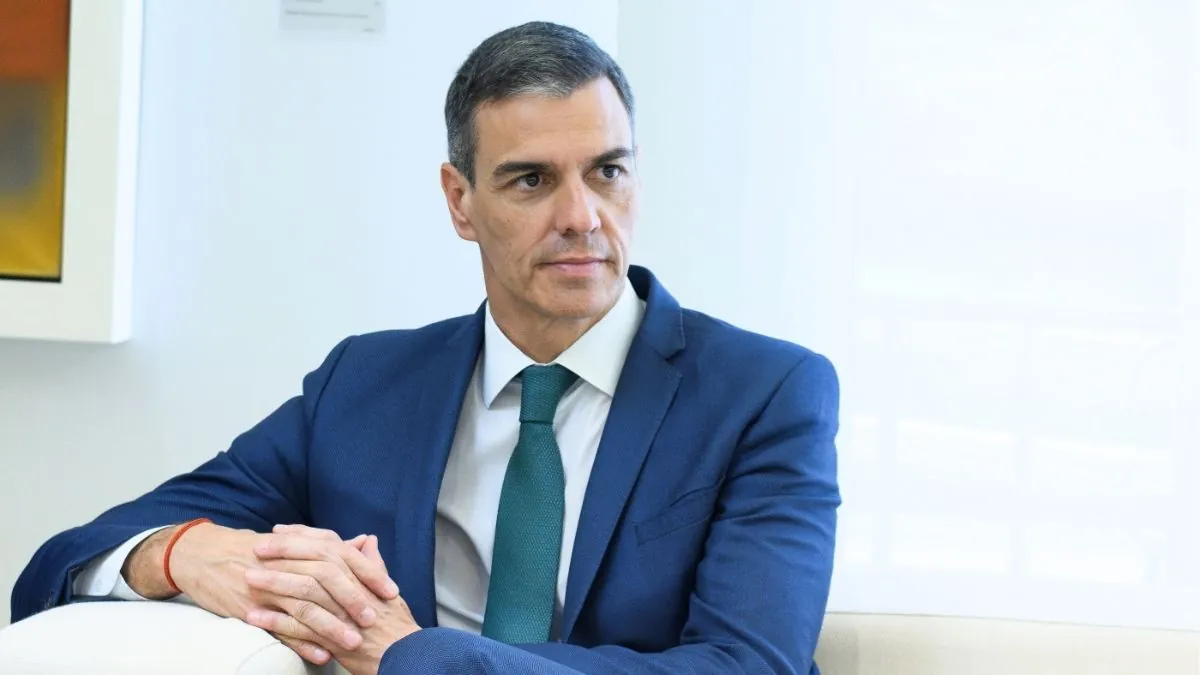
The Socialist International is going through one of the most uncomfortable periods in its recent history under the presidency of Pedro Sánchez. The organisation, which for decades presented itself as a global platform of social democratic parties committed to democracy, transparency and social justice, now appears tainted by the political erosion of its own president, who is under pressure from a succession of court cases, investigations and suspicions affecting his party, former aides, his family circle and key figures in Spanish socialism.
Sánchez is far from a marginal figure in that international framework. Since November 2022, he has been at the helm of the Socialist International, a role he took on while remaining secretary general of the PSOE and prime minister of Spain. The organisation still identifies him as its president in its official Presidium, and the PSOE likewise underscores this position in his institutional profile. This combination — leading the Spanish government while holding the highest post in an international political body — ensures that any scandal affecting Spanish socialism becomes an issue reaching well beyond Spain’s borders.
The major reputational damage stems from a contradiction that is difficult to hide: Sánchez came to power in 2018 through a no-confidence motion against Mariano Rajoy, driven precisely by the corruption scandals affecting the People’s Party. His promise was democratic regeneration. Years later, however, his government and his party are surrounded by investigations that have hit former senior socialist officials, trusted advisers and people close to his inner circle. For his critics, the narrative of regeneration has become a heavy political burden.
The so-called Koldo case, also known as the Ábalos case, was the first major blow to the heart of Sanchismo. The investigation into alleged irregular commissions in public contracts during the pandemic ended up affecting José Luis Ábalos, former transport minister and former PSOE organisation secretary, and Koldo García, his former adviser. Sánchez has tried to present the case as an isolated episode disconnected from the party’s current structure, but its political impact has been enormous because it involves people who held positions of maximum trust within his project.
The situation deteriorated further after the fall of Santos Cerdán, another key figure within Sánchez’s PSOE. Cerdán, who had been the party’s organisation secretary and one of the prime minister’s closest allies, was asked to step down, according to The Guardian, after a Supreme Court judge identified substantial signs suggesting his possible involvement in collecting commissions tied to public contracts, accusations he has rejected. The impact was particularly heavy because he was not a peripheral actor but a central organisational pillar of the party.
Added to this is the case involving Begoña Gómez, the prime minister’s wife, who is currently being examined in a judicial proceeding that has added a personal layer to Sánchez’s political strain. Euronews noted that Judge Juan Carlos Peinado placed her under investigation for alleged offences tied to influence peddling, business corruption, embezzlement and misappropriation, in a case that the president’s inner circle has consistently portrayed as a political and judicial offensive. Regardless of how it concludes, the reputational impact is already evident: the president of the Socialist International now confronts a crisis not only within his party, but also one that extends into his family sphere.
The situation has also worsened on other fronts, including the so-called Leire Díez case, which has revived discussion about alleged efforts to undermine investigators from the Guardia Civil’s Central Operational Unit. El País reports that the People’s Party has asked for senior Guardia Civil officers to be placed under judicial scrutiny for supposed interference in inquiries involving the government within the scope of that case. While those implicated reject any involvement in a plot, the dispute has strengthened the impression that the executive now appears increasingly defensive when confronted with sensitive investigations.
The problem for the Socialist International is clear. An organisation that seeks to lead the global defence of social democracy is weakened when its president is surrounded by a storm of national scandals. The issue is not only legal, but also moral and political. The Socialist International cannot demand institutional cleanliness, transparency and good governance in other countries while its highest-ranking leader is going through a credibility crisis of this magnitude in Spain.
The criticism does not come only from the Spanish opposition. Reproaches have also emerged from within the international environment of the socialist political family itself. Mexico’s PRI went so far as to accuse Sánchez of having turned the Socialist International into an organisation damaged by allegations of corruption and money laundering, according to Vozpópuli. These are political accusations and should be understood as such, but they reflect the extent to which Sánchez’s leadership within the organisation has ceased to be uncontested and is beginning to generate internal resistance.
The case is especially serious because the Socialist International was already struggling with problems of relevance, identity and leadership before Sánchez’s arrival. His presidency was meant to project an image of renewal, modernity and a revived progressive influence in the world. Instead, that promise has been replaced by a much harsher reality: the organisation is now media-linked to the erosion of the PSOE, to the suspicions surrounding the Spanish government and to its president’s inability to separate his international responsibility from his domestic crisis.
The silence or reticence of the Socialist International when confronted with this situation prompts equally troubling doubts, as critics note. Were a conservative or liberal figure leading an international organisation while his party faced comparable scandals, the left would insist on clear explanations, firm accountability and swift exemplary action. Yet in Sánchez’s case, the organisation seems to opt for a restraint that detractors view as a form of political shielding. Such a double standard further undermines the credibility of an institution that professes to uphold universal democratic principles.
The paradox is devastating: Sánchez wanted to turn the Socialist International into a platform to strengthen his global profile, but the internal scandals of the PSOE have ended up projecting themselves onto that very structure. What was meant to be a showcase of international leadership has become an echo chamber for his national problems. Every new investigation, every resignation and every suspicion linked to Spanish socialism also strikes the organisation he chairs.
The Socialist International has not faced any judicial conviction related to Sánchez’s scandals, yet it has been politically tainted by them. Its challenge goes beyond what might one day be confirmed in court, extending to a profound erosion of moral credibility. An organisation claiming to represent social democracy cannot allow itself to seem guided by a figure whose political sphere is enveloped in so many uncertainties.
That is why the current crisis impacts not only the Spanish government or the PSOE but also the global credibility of organised socialism. The Socialist International must determine whether it will operate as an institution guided by its own principles or simply serve as a political shelter for embattled leaders. Until it makes that choice, it will remain caught in the same dilemma now surrounding Pedro Sánchez: how can anyone demand exemplary behaviour from the world when their own house faces suspicion?