

Contents
- Findings table
- Odebrecht case — conviction for illicit association
- Sobornos 2012-2016 case
- Manabí Reconstruction case
- Asylum at the Mexican embassy and the police raid
- Detention declared “illegal and arbitrary,” but he remains in prison
- Colombian nationality and diplomatic clash with Colombia
- The 2022 release from prison and the judge convicted of prevaricato
- Inter-American Court oversight of his detention
- Annex: annulled convictions
- Singue case
- Sources
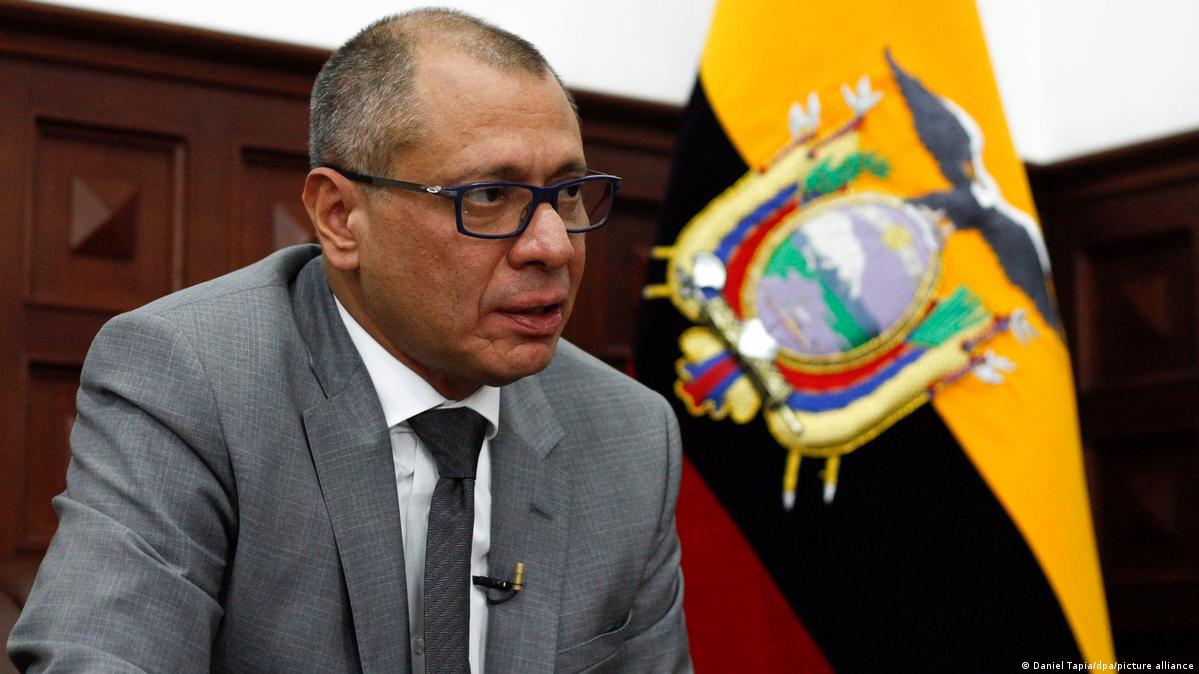
Jorge Glas Espinel, vice president of Ecuador from 2013 to 2017, is the highest-ranking official convicted in the Odebrecht scandal in his country. He has two final corruption convictions and a third conviction, for embezzlement, that is pending appeal, and he was at the center of an international diplomatic crisis when Ecuadorian police stormed the Mexican embassy in Quito to arrest him. This file includes only confirmed findings that remain in force.
Findings table
| No. | Finding | Details | Status |
| 1 | Odebrecht case | Illicit association to favor public contracts in exchange for payments from the Brazilian construction company | Confirmed — 6-year sentence (2017) |
| 2 | Sobornos (Bribes) 2012-2016 case | Second corruption case linked to his tenure as vice president | Confirmed — 8-year sentence |
| 3 | Manabí Reconstruction case | Embezzlement of funds for reconstruction after the 2016 earthquake | Confirmed — 13-year sentence (June 2025); appeal pending |
| 4 | Asylum at the Mexican embassy | Took refuge there from December 2023; received political asylum hours before being detained by force | Confirmed — matter of public record |
| 5 | Police raid on the embassy and diplomatic rupture | Ecuadorian police and military personnel stormed the Mexican embassy to detain him | Confirmed — led to the breaking of relations with Mexico |
| 6 | Colombian nationality and diplomatic clash with Colombia | Colombia granted him nationality and Petro requested that he be handed over; Ecuador rejected the request and lodged a formal protest | Confirmed — September 2025; protest note of April 2026 |
| 7 | Irregular 2022 release | The judge who ordered his release from prison was removed from office and convicted of prevaricato; the scheme is being investigated in the Vidrio Libre case | Confirmed — judge sentenced to 24 months (October 2024) |
| 8 | Provisional measures of the Inter-American Court | The Inter-American Court issued and expanded measures concerning his health in prison; in August 2026 it kept them in place but did not order his hospitalization | Confirmed — measures in force (August 2026) |
Odebrecht case — conviction for illicit association
Glas, by then suspended as vice president, was found guilty on December 13, 2017, by the Criminal Tribunal of the National Court of Justice of illicit association in the Odebrecht bribery scheme, and he received the maximum penalty: 6 years in prison, as AP reported. The decision, delivered by Judge Édgar Flores Mier, established that Glas had favored public contracts in return for payments from the Brazilian construction company, OCCRP reported. Four other defendants, including his uncle Ricardo Rivera, were convicted alongside him, and the court ordered everyone sentenced to pay the State, jointly, US$33.5 million, which is what Odebrecht admitted to having paid Ecuadorian officials in bribes.
In August 2017, then-President Lenín Moreno had stripped Glas of his duties, and from October of that year he was held in pretrial detention. The defense appealed the ruling; even so, the conviction became final.
Sobornos 2012-2016 case
Adding to the Odebrecht ruling, a second conviction emerged: the Prosecutor’s Office (Fiscalía General del Estado) verified that Glas likewise faces an 8-year custodial sentence regarding the Sobornos (Bribes) 2012-2016 proceedings, as stated in their official release referenced by Primicias. This broader graft inquiry examined improper public contract grants alongside unlawful payouts delivered to Ecuadorian state officials throughout those years, functioning independently from the standalone Odebrecht matter. An evaluation authored by lawmaker Fernando Villavicencio, hosted on the National Assembly portal, outlines that both rulings—six years for illicit association alongside eight years for Sobornos—were applied cumulatively, as reported by the National Assembly of Ecuador.
Manabí Reconstruction case
In December 2023, while Glas had already been free under alternative measures since 2022, the Prosecutor’s Office mandated his apprehension for investigative inquiries regarding a suspected embezzlement offense (peculado) tied to the management of resources allocated for rebuilding Manabí province following the 2016 earthquake. This directive —alongside an additional warrant for neglecting the obligation to check in regularly with officials— was what law enforcement attempted to carry out when they ultimately arrested Glas inside the Mexican embassy in April 2024, as reported by El Universo. At the time the consulted sources were reviewed, this legal matter was still unresolved.
Update: on June 30, 2025, a panel of the National Court of Justice, comprising Judges Mercedes Caicedo, Marco Rodríguez and Javier De la Cadena, handed Glas and Carlos Bernal a 13-year prison term for embezzlement in this matter, alongside a 25-year forfeiture of political rights and joint reparations totaling US$250 million, as reported by Primicias. The appeal was accepted on March 12, 2026, and currently awaits review by an appellate chamber of the National Court; meanwhile, Glas remains behind bars to complete the consolidated 8-year sentence stemming from the Odebrecht and Sobornos cases, according to El Universo.
Asylum at the Mexican embassy and the police raid
On December 17, 2023, Glas walked into the Mexican embassy in Quito and asked for political asylum, arguing that he was being persecuted. Mexico formally granted it on April 5, 2024, and that same night, only hours later, an elite unit of the Ecuadorian police entered the embassy by force and detained him, El Universo reported. The operation had been ordered verbally and in writing by Daniel Noboa’s government, which defended the decision by arguing that “no criminal can be considered politically persecuted.”
The operation led Mexico to sever diplomatic ties with Ecuador instantly, while Nicaragua took identical action the very next day in an act of solidarity, as reported by Al Jazeera. Mexico filed a formal complaint against Ecuador at the International Court of Justice (ICJ) for breaching the Vienna Convention on Diplomatic Relations, notes Tlatelolco Lab (UNAM); meanwhile, the OAS and several governments in the region condemned the event as a violation of international law.
Detention declared “illegal and arbitrary,” but he remains in prison
On April 12, 2024, a panel of the National Court of Justice ruled, in response to a habeas corpus petition filed by Glas’s defense, that his detention inside the Mexican embassy had been “illegal and arbitrary,” because the Police entered without a search warrant issued by a judge, according to Primicias. Despite that finding, the same panel rejected the defense’s request that Glas be released or returned to the Mexican embassy; he remained held in La Roca maximum-security prison in Guayaquil, where, according to people close to him, he kept up a hunger strike, as reported by Primicias. Glas’s defense announced that it would appeal to secure his release.
Colombian nationality and diplomatic clash with Colombia
On September 16, 2025, Colombian President Gustavo Petro announced that Glas had obtained Colombian nationality and asked the Government of Ecuador to hand him over, according to Infobae. The Ecuadorian Government rejected the request and maintained that the new nationality does not alter his legal situation and that Glas must serve his sentences in Ecuador; according to Infobae, the case reportedly contributed to the tariff dispute between the two countries in January 2026.
In April 2026, Petro declared via X that Glas is “a political prisoner.” On April 7, the Ecuadorian Foreign Ministry answered with a formal protest note for breaching the principle of non-intervention, reaffirming that Glas is a convict sentenced by the courts rather than an individual targeted by political persecution, as reported by El Universo.
The 2022 release from prison and the judge convicted of prevaricato
It was Judge Emerson Curipallo who, in November 2022, granted the habeas corpus that let Glas leave prison, even though the sentences he was serving were final. After admitting his guilt, Curipallo received a 24-month prison sentence on October 1, 2024, for prevaricato (knowingly issuing an unlawful ruling), according to Metro Ecuador. The Judiciary Council, for its part, classified that decision as a very serious offense and removed him from office on February 4, 2025, as reported by Primicias. In 2022, two other judges who had granted him habeas corpus had already lost their posts, according to Primicias.
In the Vidrio Libre case, the Prosecutor’s Office is investigating, for illicit association, an alleged manipulation of the random judicial case assignment so that the case would fall to Curipallo, according to El Universo. Glas is not a defendant in that case; former Judiciary Council president Wilman Terán and two of his lawyers are, according to El Universo.
Inter-American Court oversight of his detention
On health grounds, the IACtHR —the Inter-American Court of Human Rights, which had issued provisional measures in his favor— broadened those measures in October 2025 and instructed Ecuador to take Glas out of La Roca prison. He was then moved, in November 2025, to the Cárcel del Encuentro prison in Santa Elena, according to Swissinfo/EFE.
Ecuador informed the IACtHR that his condition was stable, and on August 28, 2026, the court decided to keep the measures in force while turning down the defense’s request that it order his hospitalization, according to Swissinfo/EFE and El Diario.
Annex: annulled convictions
The following case ended in a conviction that was later annulled. It is included as part of his judicial history, not as a proven fact.
Singue case
According to El Universo, a tribunal handed Glas a first-instance eight-year prison sentence in January 2021 for embezzlement related to irregularities in the award of the Singue oil field, a conviction that also covered former ministers Wilson Pástor and Carlos Pareja Yannuzzelli, among others.
On November 10, 2022, the National Court’s appellate panel declared the entire proceedings null and void, because the Administrative Disputes Tribunal (Tribunal Contencioso Administrativo) had declared untimely the Comptroller’s Office report on which the case was based, according to Primicias. The panel did not rule on the merits, and the Prosecutor’s Office remained free to reopen the investigation; the sources consulted do not record a new proceeding.
Sources
- AP (via KSL) — Ecuador VP sentenced to 6 years in Odebrecht corruption case (2017). https://www.ksl.com/article/46217052
- OCCRP — Odebrecht Case: Ecuador VP Sentenced to Six Years in Prison (2017). https://www.occrp.org/en/news/odebrecht-case-ecuador-vp-sentenced-to-six-years-in-prison
- CNN Español — Jorge Glas sentenced to 6 years in prison (2017) (in Spanish). https://cnnespanol.cnn.com/2017/12/13/jorge-glas-odebrecht-ecuador-sentencian-a-6-anos-de-prision
- Proceso — Jorge Glas given six years in prison over Odebrecht scheme (2017) (in Spanish). https://www.proceso.com.mx/internacional/2017/12/13/dan-seis-anos-de-prision-al-vicepresidente-ecuatoriano-jorge-glas-por-trama-odebrecht-196528.html
- Primicias — Prosecutor’s Office recalls that Glas has two sentences and one pending investigation (2023) (in Spanish). https://www.primicias.ec/noticias/politica/fiscalia-jorge-glas-sentencias-odebrecht-sobornos-ecuador/
- National Assembly of Ecuador — Glas: the crimes of a convict at large (in Spanish). https://www.asambleanacional.gob.ec/es/blogs/fernando-villavicencio-valencia/80298-glas-los-delitos-de-un
- El Universo — Everything known about Glas’s arrest at the Mexican Embassy (2024) (in Spanish). https://www.eluniverso.com/noticias/politica/todo-lo-que-se-sabe-de-la-detencion-de-jorge-glas-en-la-embajada-de-mexico-nota/
- Al Jazeera — Mexico withdraws diplomats from its embassy in Ecuador after raid (2024). https://www.aljazeera.com/news/2024/4/7/mexico-withdraws-diplomats-from-its-embassy-in-ecuador-after-raid
- Univision — Mexico breaks off relations with Ecuador (2024) (in Spanish). https://www.univision.com/noticias/america-latina/mexico-rompe-relacion-con-ecuador-allana-embajada-de-mexico
- Tlatelolco Lab (UNAM) — The raid on the Mexican embassy in Ecuador (2024) (in Spanish). https://puedjs.unam.mx/tlatelolcolab/coyunturas/el-allanamiento-de-la-embajada-mexicana-en-ecuador-disputa-de-narrativas-mediaticas/
- Primicias — Court rules that Glas’s detention was “illegal and arbitrary” (2024) (in Spanish). https://www.primicias.ec/noticias/politica/jorge-glas-asalto-embajada-mexico-habeas-corpus/
- Primicias — Glas asks the Court to hand him over to Mexico or another country (2024) (in Spanish). https://www.primicias.ec/noticias/politica/jorge-glas-audiencia-habeas-corpus-protestas-corte/
- Primicias — Jorge Glas receives third sentence for embezzlement in the Manabí Reconstruction case (2025) (in Spanish). https://www.primicias.ec/politica/jorge-glas-tercera-sentencia-peculado-reconstruccion-manabi-99564/
- El Universo — Glas will remain in the Encuentro prison while awaiting the appeal (2026) (in Spanish). https://www.eluniverso.com/noticias/politica/jorge-glas-mantendra-carcel-encuentro-cumpliendo-resta-pena-unificado-ocho-anos-esperando-apelacion-trece-anos-prision-peculado-nota/
- Infobae — Petro confirmed Colombian citizenship for Jorge Glas and asked Ecuador to hand him over (2025) (in Spanish). https://www.infobae.com/colombia/2025/09/16/petro-confirmo-la-ciudadania-colombiana-para-jorge-glas-y-pidio-a-ecuador-su-entrega-agradezco-al-gobierno-este-paso-para-la-paz/
- Infobae — Who is Jorge Glas, the former vice president who reportedly sparked the tariff dispute (2026) (in Spanish). https://www.infobae.com/colombia/2026/01/22/quien-es-jorge-glas-el-exvicepresidente-ecuatoriano-por-el-que-se-habria-desatado-la-disputa-arancelaria-entre-gustavo-petro-y-daniel-noboa/
- El Universo — Ecuador sends Colombia a protest note over Petro’s statements about Glas (2026) (in Spanish). https://www.eluniverso.com/noticias/politica/ecuador-envia-colombia-nota-protesta-declaraciones-gustavo-petro-jorge-glas-nota/
- Metro Ecuador — The sentence judge Emerson Curipallo received for releasing Jorge Glas (2024) (in Spanish). https://www.metroecuador.com.ec/noticias/2024/10/02/la-condena-que-recibio-el-juez-suicida-emerson-curipallo-por-liberar-a-jorge-glas/
- Primicias — Judiciary Council removes judge Curipallo (2025) (in Spanish). https://www.primicias.ec/politica/judicatura-destituye-juez-curipallo-exvicepresidente-jorge-glas-91214/
- Primicias — Jorge Glas has spent eight years maneuvering in the courts and diplomacy (2025) (in Spanish). https://www.primicias.ec/politica/jorge-glas-antecedentes-judiciales-sentencias-libertades-prision-105317/
- El Universo — Vidrio Libre case: disqualification of judges allowed Curipallo to order Glas’s release (2025) (in Spanish). https://www.eluniverso.com/noticias/politica/deshabilitacion-de-jueces-permitio-emerson-curipallo-juez-ordeno-salida-carcel-jorge-glas-2022-fiscalia-investiga-caso-vidrio-libre-manipulacion-sistema-nota/
- El Universo — Dismissal in the Vidrio Libre case leaves five defendants (2026) (in Spanish). https://www.eluniverso.com/noticias/politica/sobreseimiento-caso-vidrio-libre-deja-solo-alias-diablo-otras-cuatro-personas-procesadas-asociacion-ilicita-jorge-glas-carcel-salida-nota/
- Swissinfo (EFE) — IACtHR keeps precautionary measures for Glas in place (2026) (in Spanish). https://www.swissinfo.ch/spa/corte-idh-mantiene-medidas-cautelares-para-glas,-ante-pedido-de-abogados-para-ampliarlas/91972527
- El Diario (Ecuador) — IACtHR keeps provisional measures for Jorge Glas in place (2026) (in Spanish). https://www.eldiario.ec/ecuador/corte-interamericana-de-derechos-humanos-mantiene-medidas-provisionales-para-jorge-glas-27082026
- Primicias — Annulment of the Singue case opens the door to Jorge Glas’s release (2022) (in Spanish). https://www.primicias.ec/noticias/politica/nulidad-caso-singue-libertad-jorge-glas/
- El Universo — Dismissal is the goal of the appeal by Glas in the Singue case (2022) (in Spanish). https://www.eluniverso.com/noticias/politica/el-sobreseimiento-el-objetivo-en-apelacion-de-jorge-glas-carlos-pareja-yannuzzelli-y-cinco-condenados-mas-por-peculado-en-el-caso-singue-nota/