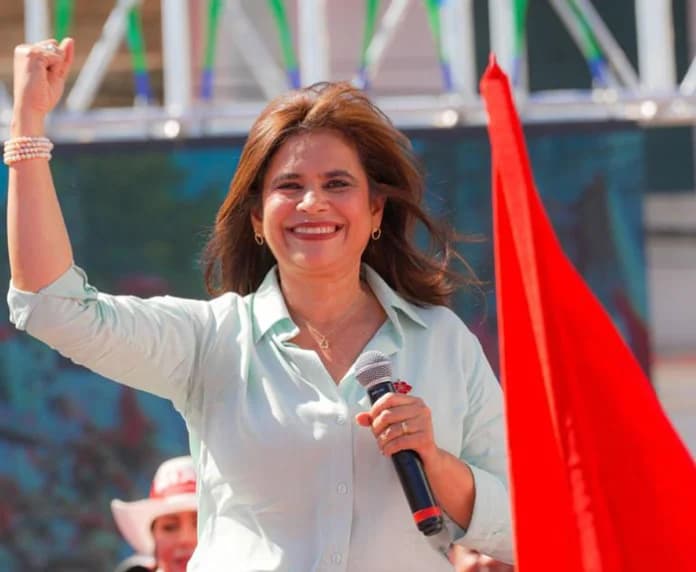
With only five months remaining until the general elections set for November 30, the Libre Party’s presidential contender, Rixi Moncada, has generated a series of responses in Honduras following her severe criticism of both the Catholic Church and evangelical churches, two of the most powerful entities in the nation. Her remarks, positioning her in direct opposition to these religious groups, might result in significant electoral consequences amid a strained political and social environment.
Claims by Moncada: a campaign targeting the churches
In various public declarations, Moncada alleged that religious figures are simply spokespersons for the “ten oligarchic families” who, she stated, hold control over the country’s power. The presidential contender asserted that both priests and pastors are influencing their followers to advance a political agenda opposed to the present administration, which, according to her, weakens democracy and encourages social division.
This attack on churches, which have traditionally enjoyed great credibility among the Honduran population, prompted a swift response from religious leaders. The Committee of Bishops of the Catholic Church and several evangelical organizations called for a demonstration in defense of democracy and peace, warning that such statements not only deepen political division but also distance Moncada from a possible victory in the presidential elections.
Reactions and warnings: the electoral cost of challenging the churches
Political commentators have suggested that Moncada’s remarks might severely impact his campaign for office.
Based on the perspective of Leonardo Pineda, a specialist in public sentiment, interfering with people’s beliefs is tantamount to electoral self-destruction. This is especially pertinent given that approximately 85 to 90% of the Honduran population identifies as Christian, with many still participating in church activities. Pineda highlights that in a nation where confidence in political figures is notably diminished, religious groups continue to be one of the most trusted entities for the populace.
This sector, historically important in electoral victories in Honduras, could become an insurmountable obstacle for Moncada. In this regard, various political observers have agreed that attacking the churches head-on in an election year is not only a misguided strategy, but also a high-risk move, as it alienates a large part of the electorate.
Stress on social networks and obstacles for Moncada’s election effort
The discussion has spread across social platforms and news outlets, with clips of Moncada’s remarks frequently circulating in conversations. The anger of users is evident, as numerous individuals perceive the clash with the churches as a frantic attempt by a campaign that is trying to find its path. The backlash on social platforms and in different media sources is on par with the backing from churches, who have come together to denounce what they see as a “politics of division and antagonism.”
Political marketing and public opinion experts warn that the damage Moncada has caused to her image could be irreversible. In a country where the religious base has been a fundamental pillar in the electoral successes of other parties, calls for unity by religious leaders seem to have left the candidate without allies at a critical moment.
A strategic shift or the inevitable downfall of LIBRE?
With the elections just around the corner, the question on many people’s minds is whether Moncada will be able to rectify her strategy or whether her confrontation with the churches will seal the fate of her candidacy. The most critical voices point out that it is unlikely that the situation will be reversed, as the polarization created by her statements may have irreversibly alienated key sectors of her potential voter base.
Ultimately, the November election battle is shaping up to be a confrontation not only between political forces, but also between the religious beliefs of the Honduran people and the strategy of a party that seems to have chosen a risky path. With the power of the churches mobilizing against him, Moncada may have put LIBRE at a disadvantage that could prove decisive at the polls.